


Sommaire :
- Qu’est-ce que le DSO : la définition
- How to calculate DSO: the formulas
- The accounting formula
- The sales exhaustion formula
- How to optimize your DSO: actions
What is DSO: the definition
DSO, Days Sales Outstanding (the days sales outstanding is a financial indicator used to measure the speed with which a company is able to collect receivables from its customers. It is a key indicator for customer risk management and credit management.
This is the average number of days it takes a company to collect its invoices.
The variables that influence average payment time are :
- The total number of invoices issued,
- Visit payment terms of customers,
- The average length of customer payments,
- Customerdisputes or late payments,
- The total amount of the company’s of the company,
Plus the DSO is lowthe faster the company is able to collect its receivables. receivableswhich may indicate a healthy financial health.
A DSO highon the other hand, may indicate that the company is having difficulty collecting its receivables. Ce qui peut entraîner des problèmes de cash flow and lower profitability.
Monitoring DSO therefore enables a company to manage its cash flow and make informed financing decisions.
As a general rule, a DSO of 30 days is considered acceptable, while a DSO of over 60 days may be considered high and could lead to cash flow problems. cash flow for the company.
Statistics on late payment by French companies :
- 2020: 14 days’ average late payment
- 2021: 12.5 days’ average late payment
In 2022, late payments are on the rise again. B2B companies, for example, increased the number of late payment days by 1.5 times between 2021 and 2022.
Far ahead, however, are B2G companies in the public sector, with an increase of 2.6.
How to calculate DSO: the formulas
The accounting formula for calculating DSO :
DSO = (Total receivables / Total sales) x Number of days in the period under review
Vous devez d’abord diviser le montant total des créances de l’entreprise par ses ventes totales sur la période considérée.
This will give you the percentage of its sales that have not yet been collected in the form of receivables. receivables.
Ensuite, vous multipliez ce pourcentage par le nombre de jours dans la période considérée (par exemple, 30 jours pour un mois, 365 jours pour une année).
Cela vous donnera le nombre moyen de jours qu’une entreprise met pour encaisser ses factures.
Par exemple, si une entreprise a des créances d’un montant total de 50 000 euros et des ventes totales de 100 000 euros sur un mois, son DSO sera de :
DSO = (50,000 euros / 100,000 euros) x 30 days = 15 days
This means that the company takes an average of 15 days to collect its invoices.
This is undoubtedly the simplest and fastest formula. However, this formula assumes stable sales. In the case of variable sales, the result is often distorted.
The sales depletion formula for calculating DSO :
Prenons l’exemple d’un CA variable sur une période de deux mois.
Month 1 (31 days): Total accounts receivable – Total sales = positive result = Accounts receivable exceeds sales
The DSO is therefore greater than 31 days.
Month 2 (28 days): Total amount of outstanding receivables – Total amount of sales = negative result = No outstanding receivables.
The DSO is therefore less than 59 days.
For example, if a company has trade receivables totaling 50,000 euros in January for total sales of 20,000 euros. It records sales of 40,000 euros in February. Then its DSO will be :
Customer outstandings in January (31 days): 50,000 – 20,000 = 30,000
Calculation of outstanding balance for the month of February (28 days): (30,000 / 40,000) x 28 = 21 days
DSO = 31 days + 21 days
This means that the company takes an average of 52 days to collect its invoices.
How to optimize your DSO: actions
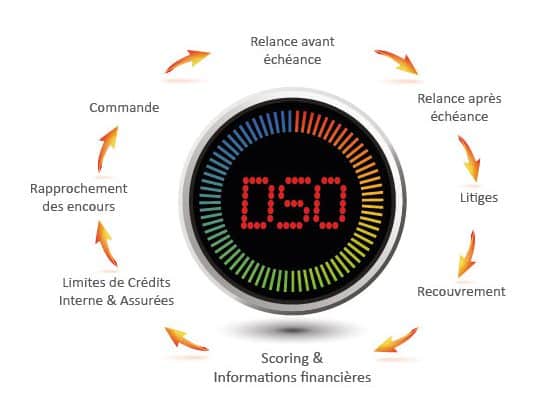
Optimizing your DSO usually involves the use of collection software. Il permet de relaunch customers on time with an automated reminder, avoiding late payment late payments. De suivre le profil de ses clients à l’aide d’un historique complet…
With Aston AI, you can automate up to 80 percent of dunning/collection tasks and significantly reduce your DSO.
To calculate your DSO without starting from scratch, download our Excel template for accounts receivable aging and DSO.


